

Case Study: The 3 Month Turnaround: $143K in Revenue and a 10x ROAS With Meta Ads
Industry: Homeware E-commerce brand
Target ROAS: 5x
Timeframe: August to November 2025
Ad Spend: $14,209.45
Revenue Generated: $143,089.17
ROAS Achieved: 10.07x
Goal: Profitable scaling + new customer acquisition
When I started working with this homeware brand, they had popular products, strong branding, and had shown market validation.
But like many growing eCommerce brands, there were gaps in the wider growth strategy.
They were running ads, but:
• Creative testing lacked structure
• Social proof was limited
• Email flows were underutilized
• Tracking needed tightening
• CAC vs LTV was not clearly understood
Ads were being used, but the ecosystem around them wasn’t fully optimized and this was impacting overall profitability.
Audience & Account Structure
I simplified the account and focused purely on clear, acquisition driven campaigns. Instead of overcomplicating the structure with unnecessary segmentation, I consolidated budgets into high intent campaigns that were optimized for conversions. I built strong retargeting layers to capture warm traffic effectively and removed underperforming segments quickly to protect performance. The goal was clarity and control before scaling, ensuring the account had a strong foundation rather than relying on scattered tests.
Ad Copy & Creative Testing
Creative was treated as the growth engine from the start. I tested a range of angles including UGC style content, benefit led messaging, problem aware hooks, gifting positioning versus self purchase angles, and short form video compared to static creative. Winning creatives were scaled quickly and decisively, while weaker angles were cut without hesitation. Meta performance today is driven heavily by creative, so the majority of our strategic focus was placed on developing and refining high performing messaging and visuals.
Conversion & Ecosystem Optimisation
Beyond the ads themselves, I advised on strengthening the wider conversion ecosystem. This included refining product page messaging, increasing visible social proof, improving email flows to better support paid traffic, and tightening tracking accuracy to ensure clean data. There is no point scaling traffic if your website cannot convert it efficiently, so aligning paid media with conversion fundamentals was a key part of driving sustainable profitability.
Results:
In just 3 months, this strategy generated $143,089.17 in revenue from only $14,209.45 in ad spend, delivering a 10.07x return on ad spend.
That means for every $1 invested, the brand generated $10.07 back in revenue.
The original target was 3x and I was able to more than triple it.
10.07x ROAS – Far Beyond Target
Exceeding the 3x target by over three times demonstrated that the structure, creative strategy, and optimisation approach were working at a fundamental level.
Profitable & Controlled Scaling
Revenue growth was achieved without aggressive spend spikes or risky scaling tactics. Budgets were increased strategically and only behind proven winners, protecting margin while accelerating growth.
Efficient New Customer Acquisition
The focus was on acquiring new customers at a sustainable cost, not simply driving revenue from existing demand. This strengthened long-term brand growth and reduced reliance on repeat purchases alone.
A Repeatable Growth Framework
Most importantly, this was not a short-term performance spike. The account was structured around a repeatable acquisition system that could continue scaling predictably and profitably.
Case Study: From Fragmented to Profitable: Generating at 5.28x ROAS & $119K with Google Ads
Industry: Fashion E-commerce brand
Target ROAS: 3x
Timeframe: June 2024 to June 2025
Ad Spend: $22.5K
Revenue Generated: $119,000
ROAS Achieved: 5.28x
Goal: Drive profitable new customer acquisition at a sustainable blended CAC while building a Google strategy that strengthens and complements Meta performance.
This fashion brand had established demand with Meta ads, but lacked structural clarity within its Google Ads account.
Branded and non-branded traffic were not clearly separated, Performance Max was operating without defined performance parameters, and attribution did not provide sufficient transparency across channels and attribution lacked transparency. Most importantly, there was limited visibility into how paid acquisition was affecting blended customer acquisition cost and contribution margin.
Before increasing spend, the priority was to introduce structure, transparency, and measurable profitability.
Branded Control & Incrementality Clarity
Branded and non branded traffic were separated to protect high intent demand while creating clear visibility into true acquisition performance. Branded campaigns were structured to maintain strong impression share and defend against competitors, but without inflating overall results. This allowed us to accurately measure incremental growth and ensure performance reporting reflected genuine new customer acquisition rather than existing demand capture.
Profitable Unbranded Acquisition
High intent, commercially focused search campaigns were built around purchase driven queries to capture users actively searching for products, not broad discovery traffic. Campaigns were optimised toward ROAS and contribution margin rather than traffic, ensuring revenue growth did not come at the expense of margin. Blended CAC was monitored alongside campaign performance so scaling decisions strengthened overall business profitability, not just individual campaign metrics.
Cross-Channel Alignment
Performance Max was implemented strategically to complement Meta’s demand generation rather than operate in isolation. Product feeds were refined, tracking accuracy was ensured, and campaigns were aligned to ROAS objectives to prevent inefficient spend. Google was positioned to capture high intent demand created by Meta prospecting activity, creating a cohesive multi-channel acquisition framework that improved overall paid performance and scalability.
Results:
Over a 12-month period, this strategy generated $119,000+ in revenue from $22,537 in ad spend, delivering a sustained 5.28x return on ad spend.
That means for every $1 invested, the brand generated $5.28 back in revenue.
The objective was profitable new customer acquisition at a sustainable blended CAC, while aligning Google to strengthen overall Meta performance.
That objective was delivered consistently over time.
5.28x ROAS – Sustainable & Consistent Growth
This performance was maintained across a full year, not driven by a short-term spike or peak sale period. By separating branded and non-branded demand, results reflected genuine acquisition performance rather than inflated reporting.
Profitable & Controlled Scaling
Revenue growth was achieved without aggressive spend increases or inefficient automation. Budgets were expanded strategically and only where contribution margin and blended CAC supported it, protecting overall profitability while scaling.
Efficient New Customer Acquisition
Unbranded campaigns captured high-intent buyers at a commercially viable cost, strengthening new customer growth rather than relying solely on existing brand searches. Google effectively captured bottom of funnel demand generated through Meta prospecting activity.
A Structured, Multi-Channel Growth Framework
This was not campaign-level optimisation. The account evolved into a structured, measurable acquisition system combining demand capture, controlled automation, and cross channel alignment. The result was predictable, sustainable growth over a 12-month period.
Case Study: Achieving $345K in Revenue in seven months with a 8x ROAS through Pinterest Ads
Industry: Arts and Crafts E-commerce brand
Target ROAS: 3x
Timeframe: January to July 2024
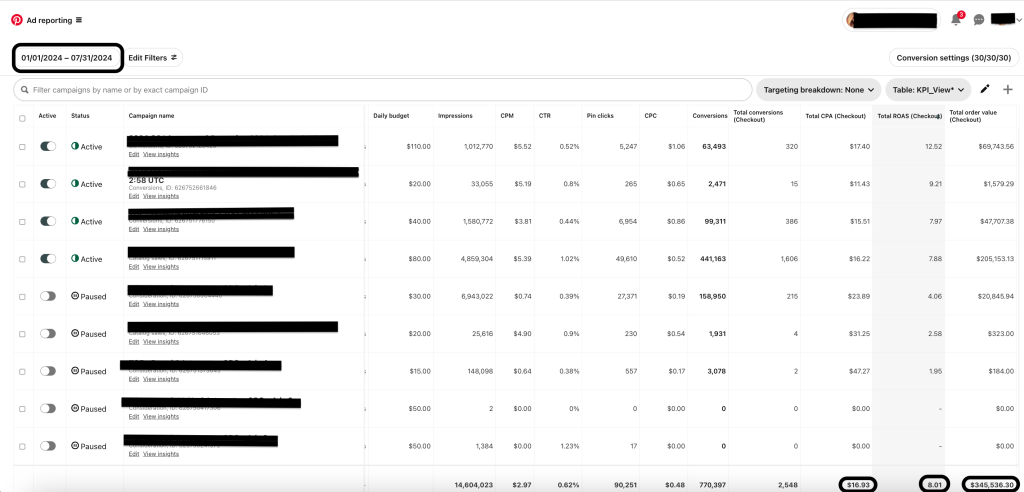
Ad Spend: $43,126.63
Revenue Generated: $345,536.30
ROAS Achieved: 8.01x
Focus: Acquiring new customers
In January 2024, I began working with this client who had previously advertised on Facebook and Instagram and wanted to expand their advertising efforts to Pinterest. As you can see here, we spent $43,126.63 over seven months, averaging $6,100 per month, and from that investment, we generated just over $345,536.30k in revenue, resulting in a 8.01x return on ad spend.
Audience Testing
Identifying the right audience is crucial. I started by creating various audience segments based on interests, behaviours, and demographics that align with Pinterest's user base. I then implemented A/B testing to find the most responsive audience groups, adjusting parameters based on performance data.
Ad Copy and Creative Testing
I crafted multiple versions of ad copy and creatives to see which combinations resonated most with the target audience. I focused on visually appealing and inspirational content, as Pinterest users are highly visual and engage more with aesthetically pleasing ads. I then regularly refreshed creatives to prevent ad fatigue and maintain high engagement rates.
Offer Testing
I tested different offers to determine what drove the highest conversion rates. This included discounts, bundles, and exclusive deals. I then analysed performance metrics to identify which offers appealed most to new customers and led to increased sales.
Results:
8.01x ROAS – More Than Double the Target
Achieved an 8.01x return on ad spend, significantly outperforming the initial 3x target. This was not driven by short-term tactics, but by structured audience targeting, disciplined optimisation, and consistent creative testing.
$345K in Revenue – Scalable and Profitable
Generated $345,000 in revenue through Pinterest, demonstrating the platform’s ability to drive meaningful commercial impact when managed strategically. Performance was achieved while maintaining efficiency, proving Pinterest can be a scalable acquisition channel, not just a supporting platform.
Strong New Customer Growth
Successfully attracted and converted new customers through high-intent targeting and creative aligned to purchase behaviour. This strengthened long-term brand growth and reduced reliance on repeat demand, positioning Pinterest as a true acquisition driver within the wider paid strategy.
Case Study: From Zero to $710K: Generating Profitable Google Revenue in 9 Months With 20.46x ROAS
Industry: Arts and Crafts E-commerce brand
Target ROAS: Undefined
Timeframe: September 2024 to June 2025
Ad Spend: $34.7K
Revenue Generated: $710K
ROAS Achieved: 20.46x
Focus: Expand beyond Meta and build a profitable multi channel acquisition strategy
This arts and crafts brand had built a strong presence through Meta advertising and organic community growth. They had an engaged audience, repeat customers, and consistent organic sales.
However, Google Ads had never been tested.
The objective was not simply to “add another channel.” It was to build a Google strategy that could:
• Capture high intent search demand
• Support and strengthen Meta activity
• Monetise brand familiarity created through paid social
• Drive incremental revenue beyond existing organic sales
The challenge was to design a structured expansion that complemented existing performance without cannibalising it.
Brand & Demand Capture Alignment
Given the brand’s strong organic following and Meta activity, branded search was structured to efficiently capture high intent demand. Campaigns were built to defend branded traffic, maintain strong impression share, and ensure competitors were not intercepting searches. At the same time, performance was monitored carefully to ensure we were measuring incremental impact rather than simply reporting on existing demand.
High-Intent Non-Branded Acquisition
Non branded campaigns were structured around commercially relevant, purchase driven keywords aligned to core product categories and customer intent. Rather than targeting broad hobby related traffic, the focus was on users actively searching for specific products and solutions. Campaigns were optimised toward ROAS and contribution margin rather than traffic volume, ensuring revenue growth supported overall profitability. This allowed Google to act as a true acquisition channel, not just a supporting traffic source.
Cross-Channel Reinforcement with Meta
Google Ads was positioned to capture bottom of funnel intent generated by Meta prospecting activity. As Meta drove awareness and engagement, Google captured users searching for the brand, product names, and related high intent queries. This created a cohesive multi channel acquisition system where paid social generated demand and search converted it efficiently. Attribution was structured to provide clearer visibility across touchpoints, strengthening budget allocation decisions across both platforms.
Results:
20.46x ROAS – Exceptional Efficiency
Delivered a 20.46x return on ad spend, meaning every $1 invested generated $20.46 in revenue. For a brand that had never previously run Google Ads, this demonstrates disciplined structure, high intent demand capture, and strategic budget allocation from day one.
$710K in Revenue in 9 Months
Scaled Google from zero presence to a $710,000 revenue channel within 9 months. This materially expanded the brand’s paid ecosystem beyond Meta and established Google as a core, revenue-driving growth engine.
Profitable Multi-Channel Expansion
Built a structured Google strategy that complemented Meta performance, capturing high intent searches generated by paid social and organic activity. The result was a cohesive, scalable acquisition system that reduced single channel reliance and strengthened overall paid performance.
Case Study: Achieving $85K in Revenue in Four Months with a 4.39x ROAS through Meta Ads
Industry: Homeware E-commerce brand
Target ROAS: 2.5x
Timeframe: February to May 2024
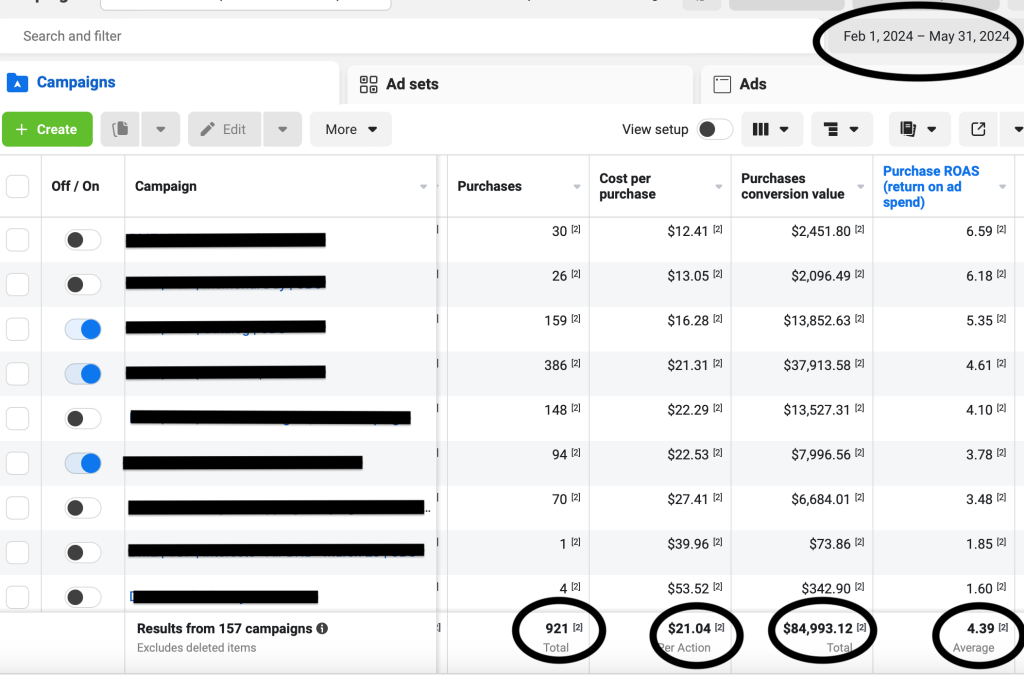
Ad Spend: $19,373.92
Revenue Generated: $84,993.12
ROAS Achieved: 4.39x
Focus: Acquiring new customers and incentivising existing customers to repeat purchase.
Before working together, this client had tried running ads themselves from November 2023 to January 2024 but had a high $42 to acquire a customer (CPA) and a ROAS below 2x. They needed better results, so here’s the 3-step formula I used to more than double their ROAS and cut their CPA in half.
Audience Testing
To start, I created multiple audience segments including custom audiences based on existing customer data, lookalike audiences from top customers, and interest-based audiences targeting specific interests related to the products. I then set up ad sets for each audience segment, allocating a small budget of $10-$20 per day per ad set to efficiently identify which segments were most responsive. By monitoring metrics such as CTR, conversion rates, and CPA over a 1-2 week testing period, I was able to identify top-performing audiences. I then reallocated the budget from underperforming ad sets to the high-performing ones, maximising ad spend efficiency. This approach helped me to pinpoint the most profitable audiences, significantly boosting our overall ROAS.
Ad Testing - Copy, Creatives, and Offers
I created multiple variations of ad copy, creatives, and offers to determine which combinations drove the most conversions. This included testing different headlines, descriptions, and calls-to-action, as well as using a mix of images, videos, and carousels to see what captured the audience’s attention best. i also experimented with various promotions like discounts, free shipping, and bundle deals. By setting up A/B tests with 2-3 variations in each ad set, I could robustly test different elements. I monitored CTR, conversion rates, and ROAS to identify winning combinations, scaling successful ads and refining or eliminating underperforming ones. This testing process ensured I found the most compelling ad elements to drive conversions and improve overall ad performance.
Offer Testing
I created different funnel stages, including Top of Funnel (TOFU) targeting broad audiences, Middle of Funnel (MOFU) retargeting website visitors and engaged users, and Bottom of Funnel (BOFU) for high-intent users and cart abandoners. I tested campaign structures by running a single campaign with TOFU, MOFU, and BOFU ad sets and separate campaigns for each funnel stage to better control budget allocation and optimisation. By tracking performance across the funnel, I identified drop-off points and areas for improvement. I adjusted campaign budgets, ad placements, and targeting strategies based on the data. This structured approach ensured maximum performance at each funnel stage, enhancing overall conversions and efficiency.